Compliance Is a Monster, Only If You Don’t Look at It
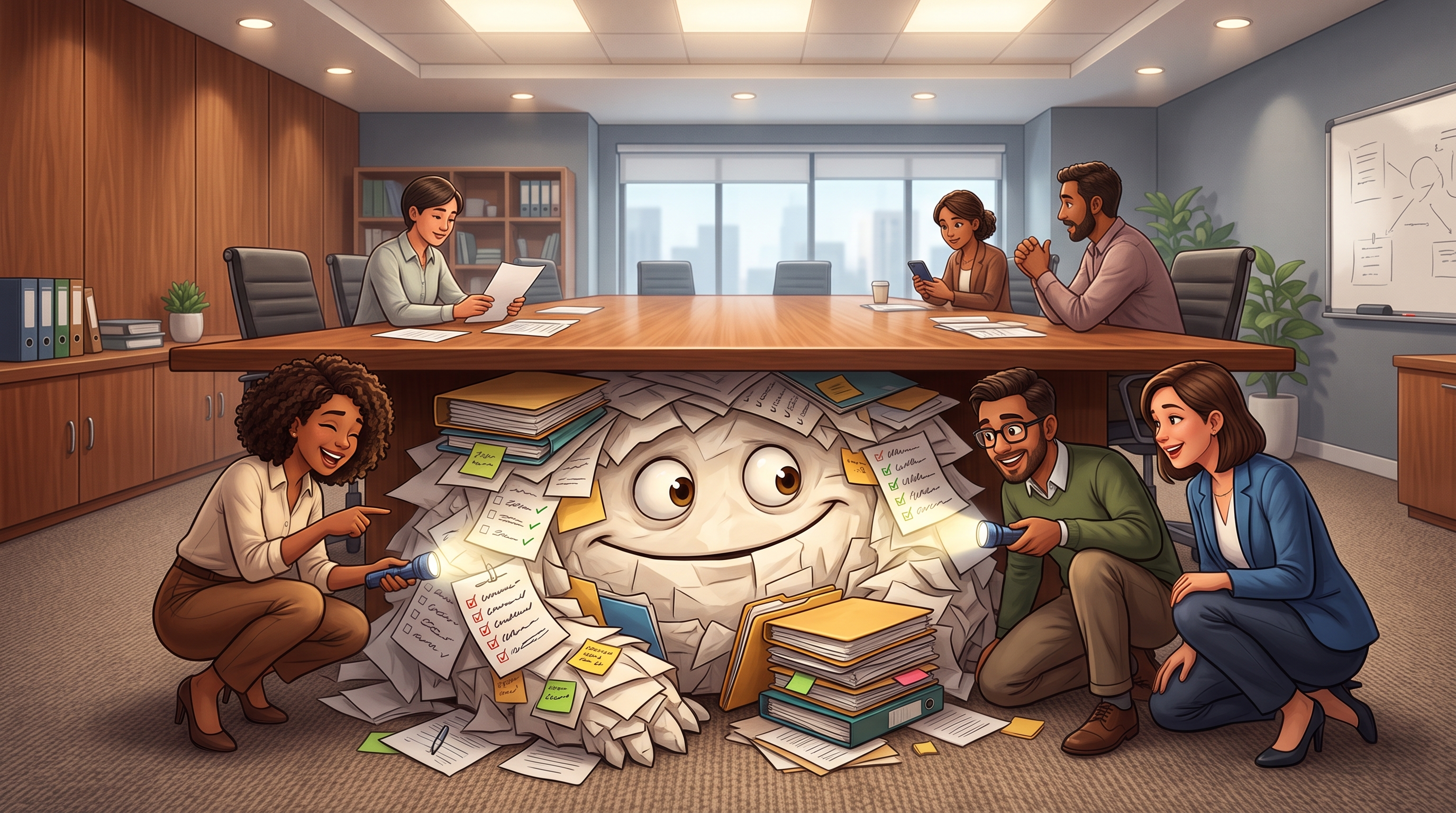
Meet the Monster Under the Desk
Every office has its monsters. Some are easy to spot: the printer that jams during board meetings, the coffee machine that breaks on Mondays, the spreadsheet that eats your data. But there’s one beast that’s both omnipresent and invisible—compliance.
Not because the rules are impossible. Not because the auditors are out to get you. But because most companies treat compliance like the monster under a child’s bed: if you don’t look at it, maybe it won’t bite.
Here’s the thing about monsters. If you refuse to look, they only get bigger. And when you finally have to turn on the light—usually after something goes bump in the night—you find out too late that it wasn’t just your imagination.
The “Hope and Pray” Compliance Strategy
Let’s be honest. For a lot of businesses, compliance is a checkbox at the end of a project. “Yes, we have data controls.” “Sure, we train employees.” “Absolutely, our passwords are strong.” You sign the forms, send the emails, and hope that’s enough.
This strategy is as effective as hiding behind your fingers during a horror movie. You know the monster is still there, but if you don’t see it, maybe it won’t see you.
Except, of course, it does. And it waits.
Plenty of organizations claim they have controls, but never actually check if those controls work—or even exist. The result? Gaps you never see, until the day someone actually tries the door and finds it unlocked. According to Corporate Compliance Insights [1], this “tick-box” approach creates hidden exposures that only emerge during a crisis.
The Monster Bites Back
The “nothing will happen to us” attitude is popular—right up until something does happen. A breach, a leak, a regulator with a clipboard and a bad attitude. Suddenly, the monster isn’t under the bed. It’s sitting at your desk, eating your lunch, and asking for your company credit card.
Here’s the real horror story: a significant number of companies that suffer a security breach don’t just get a slap on the wrist or a stern letter. They go out of business. The damages—legal, reputational, operational—are simply too much to survive. That’s not a scare tactic; it’s a post-mortem. Thoropass [2] points out that the aftermath of a serious breach is often a terminal event for the business.
You won’t see this in the sales brochures for compliance software. But you will see it in the bankruptcy filings.
Compliance as Insurance (Not Garlic or Silver Bullets)
Let’s try a less terrifying metaphor. Compliance isn’t a wooden stake or a silver bullet. It’s insurance. Not the kind that prevents you from ever getting sick, but the kind that keeps you from losing everything if you do.
Nobody buys health insurance because they expect to end up in the hospital. You buy it so you can sleep at night, knowing that if the worst happens, you’ll have a fighting chance. Business compliance is the same. It won’t stop every threat, but it means you’re covered when things go wrong.
ProSight Financial Association suggests that this framing—compliance as insurance—helps organizations understand that while you can’t prevent every bad event, you can make sure you survive it source [3].
The twist? Unlike health insurance, which threatens your life, compliance failures threaten your company’s life. And while your business isn’t a living, breathing organism, it can die a very real death when the monster bites.
Why Compliance Feels Like a Monster
If compliance feels heavy, it’s not because the rules are impossible to meet. It’s because most organizations are unstructured, fragmented, or purely reactive. You get a checklist from a consultant, you fill it out, you hope for the best.
But hope is not a strategy. And a checklist isn’t a shield.
The real weight comes from the chaos: controls scattered across spreadsheets, policies no one reads, evidence stored on someone’s desktop, and a mad scramble whenever an auditor appears. The monster gets bigger the longer you ignore it. Corporate Compliance Insights [4] notes that the “heaviness” is a symptom of poor organization, not regulatory overreach.
The Shift: From Paperwork to Product Feature
Here’s where the story takes a turn for the better. The companies that have stopped treating compliance as a paperwork exercise—and started treating it as a product feature—find that the monster shrinks dramatically.
Modern compliance isn’t something you bolt on at the end of a project, like a bumper sticker on a company car. It’s baked into every deployment, every new feature, every employee onboarding. In software, this means tying compliance checks to every pull request, ticket, and deployment pipeline—not just at audit time, but always. DevOps Oasis [5] describes this as “compliance without tears”—if you build it in, you don’t have to fear it later.
This approach isn’t just for tech companies. Every business can benefit from making compliance a routine part of operations. It means fewer surprises, less panic, and—best of all—a monster that stays in the closet, where it belongs.
Automation: The Monster Tamer
One reason compliance used to be so scary? It was all manual. Paper trails, signatures, endless emails, and the ever-present risk of losing the one USB stick with your audit evidence.
That’s changing. Automation, analytics, and workflow tools are turning compliance from a mad scramble into a routine. Instead of digging through inboxes or hoping someone remembered to update the policy, you get dashboards, alerts, and evidence trails. Protecht Group [6] highlights that modern compliance programs are built around automation, monitoring, and structured evidence—not one-off documentation exercises.
The result: less friction, more confidence, and a monster that’s more teddy bear than terror.
Making Compliance Less Scary (and Less Annoying)
Here’s a practical tip: simplify access control. Use Single Sign-On (SSO) everywhere. Base permissions on groups, not individuals. Review access fast and often. These aren’t just security best practices—they’re compliance enablers. And they reduce the time your team spends wrestling with the monster. DevOps Oasis [5] points out that these changes cut compliance friction to the bone.
More broadly, compliance is about establishing structured processes, standardized controls, and easy-to-produce proof. When you do this, you cut both risk and operational hassle. VComply [7] notes that the right structure makes compliance a background hum, not a blaring alarm.
The Real Risk: Not Looking
If you treat compliance as a box to tick, you’re gambling with your company’s life. Maybe the monster won’t come out this quarter. Maybe not this year. But eventually, every company gets tested. And if you haven’t looked the monster in the eye—if you haven’t built compliance into your operations—you’ll find out just how sharp its teeth are.
The lesson isn’t to fear compliance. It’s to stop pretending it’s not there. Look at it. Understand it. Build it into your business, not as an afterthought, but as part of the foundation.
Because the only thing scarier than the compliance monster is finding out, too late, that it was real all along.
Sources
- Contracts and Compliance: What You Don't Know Might Hurt You — Corporate Compliance Insights · press
- Compliance Horror Stories: How to Avoid Them — Thoropass · vendor · interested party
- Taming the Compliance Monster — ProSight Financial Association · source
- Compliance Does Not Block Innovation: A Mindset Shift — Corporate Compliance Insights · press
- Compliance Without Tears: Practical Guardrails for DevOps — DevOps Oasis · blog
- Compliance Best Practices Guide — Protecht Group · vendor · interested party
- What Is Compliance? — VComply · vendor · interested party